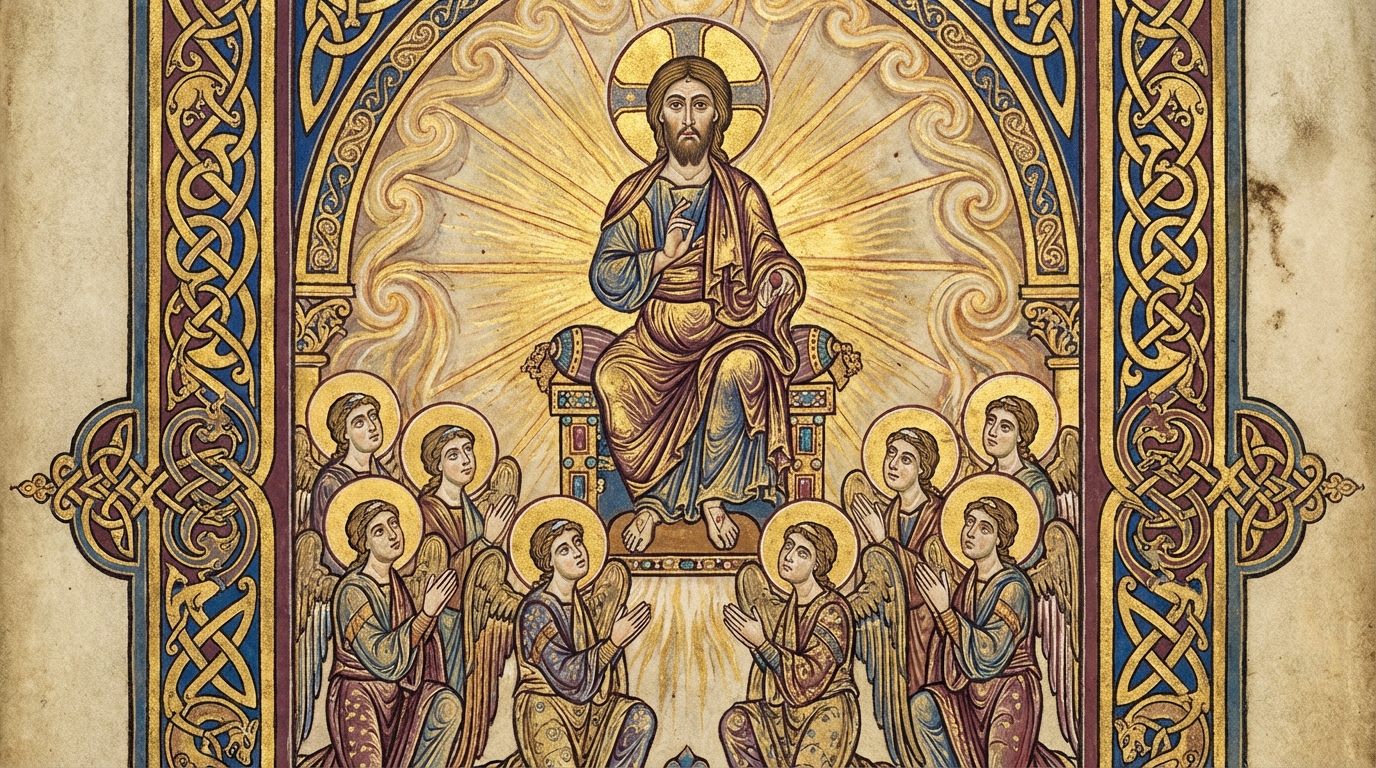
God spoke of old by the prophets, but now by his Son, who is incomparably greater than the angels.
1.1 'God, who at sundry times and in divers manners'—revelation was partial and progressive in the Old Testament, through prophets, theophanies, and types.
1.2 The contrast: many times, many ways (OT) versus once and perfectly (Christ).
2.1 'In these last days hath spoken to us by his Son'—the definitive, final revelation is not a book or a doctrine but a Person.
2.2 'By whom also he made the world'—the Son is the agent of creation (cf. John 1:3, Col 1:16). He is not a creature but Creator.
3.1 'The radiance of his glory' (apaugasma tēs doxēs)—Christ is the effulgence of the Father's glory, eternally emanating from Him like light from the sun.
3.2 'The exact imprint of his being' (charaktēr tēs hypostaseōs)—the Son perfectly expresses the Father's very substance. He is homoousios (same substance) with the Father.
3.3 'Upholding all things by the word of his power'—Christ sustains the universe in existence moment by moment. Creation depends on His continuous will.
3.4 'Purgation of sins... sat down on the right hand'—the priestly and kingly offices united. Having completed His sacrifice, He reigns forever.
6.1 'Let all the angels of God adore him'—quoting Deuteronomy 32:43 (LXX). Angels worship the Son, proving He is not an angel but God. Worship belongs to God alone.
8.1 'Thy throne, O God, is for ever and ever'—the Father addresses the Son as 'God' (ho theos). A direct scriptural assertion of Christ's divinity from Psalm 45:6-7.
10.1 'Thou, Lord, in the beginning didst found the earth'—quoting Psalm 102:25-27, which speaks of Yahweh, and applying it to Christ. The Son is Yahweh.